
Everything you need to know about Dementia
- Amanda Massengale
- Feb 21, 2019
- 6 min read


What is Dementia?
Dementia is a disease that causes cognitive functioning, which includes your ability to think, and mental, including emotional and behavioral, functioning to become affected. Dementia can cause those with it to lose their capability to carry out daily tasks due to loss of memory, ability to think, recognition of time and place, and recognition of people. At this time, it is estimated that about 10% of people of the age 65 and older are affected by dementia and it seems to increase with age. Only about 5% of those 65-74 years old have dementia but it increases to about 30% for those of the age 85 and up (Ministry of Health, 2019).
General Symptoms of Dementia
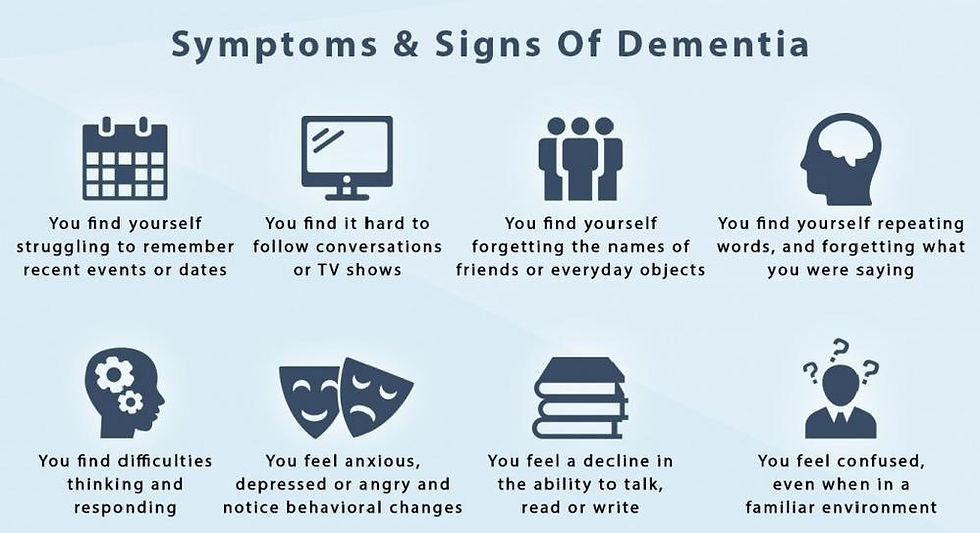
Symptoms of dementia can be seen early on but they are very subtle and vague depending on the type of dementia, therefore they may not be directly recognizable. Varying according to the patient, early signs of dementia include memory problems relating to recent events, loss in the ability to concentrate, increased amount of confusion, personality or behavioral changes, withdrawal from relationships or activities, and the loss in ability to carry out daily tasks. At this stage in someone’s life, those around them fail to recognize these symptoms as a problem because they assume these behaviors and loss of abilities are common aspects of the ageing process in all senior citizens. These symptoms also may go unnoticed for a long period of time due to the slow growth of the symptoms, making it hard to recognize a drastic change (Department of Health & Human Services, 2014).
7 Stages of Dementia
Dementia can be defined by seven different stages to help caregivers understand what they should be expectant of and when they should expect it. The scale most commonly used to measure the progression of dementia in patients is the Global Deterioration Scale of Assessment of Primary Degenerative Dementia (GDS) or more commonly known as the Reisberg Scale.
The first broad category is “No Dementia” which includes stage 1, stage 2, and stage 3. Stage 1 is diagnosed to those who function normally and are mentally healthy with no signs of dementia. Stage 2 shows the progression of dementia through a very mild cognitive decline in a patient. Forgetfulness is normal and can be seen as a normal sign of aging. In this stage, medical professionals and loved ones do not see strong symptoms of dementia. The last stage in the “No Dementia” category is stage 3 which shows a mild cognitive decline. Increase forgetfulness is apparent as well as decreased work performance, problems with speech, and issues with focusing on normal tasks. This stage could last about 7 years before reaching stage 4.
The “Early-Stage Dementia” category only consists of stage 4, which shows a moderate cognitive incline and can last about 2 years. These cognitive issues can be detected during a medical interview and an exam. Symptoms of stage 4 dementia include misplacing items, forgetting recent conversations, creating complete sentences, losing track of days and times, losing interest in normal activities, increased irritability, trouble remembering the names of new people, and having trouble planning and organizing.
“Mid-Stage Dementia” is the next category and it includes stage 5 and stage 6. Stage 5 displays moderately severe cognitive decline whereas stage 6 displays severe cognitive decline that may result in patients forgetting the names of loved ones and they may have very little memory of recent events.. Mid-stage dementia patients need assistance to complete tasks and live out life day-to-day. Communication begins to decline drastically and delusions begin as well as compulsions, anxiety, and severe agitation. Symptoms specific to mid-stage dementia include problems sleeping due to the confusion of day and night, not knowing how to behave in public, wandering, perception issues, hallucinations, increased aggression, inability to remember personal information, and change in sleep patterns.
The final category is “Late-Stage Dementia” and it consists of stage 7, the final stage. In this stage there is a very severe decline in cognitive abilities, and it can last about 2.5 years. During this stage a person may lose their ability to speak or communicate and they will require assistance with most activities. Symptoms include trouble eating, weight changes, incontinence, loss of speech, restlessness, outbursts when confused, and increased vulnerability to infections (The 7 Stages of Dementia, 2019).

Dementia Types
Dementia can be defined by many different types including Creutzfeldt-Jakob Disease, Lewy Body Dementia, Alzheimer’s Disease, Frontotemporal Dementia, Huntington’s Disease, Mixed Dementia, Parkinson’s Disease Dementia, Vascular Dementia, and Korsakoff Syndrome.
Creutzfeldt-Jakob disease occurs when prion protein begins to form three-dimensional shapes triggering prion protein in the brain to fold, destroying brain cells. This can lead to a rapid decline in brain function and causes the dementia to get worse unusually fast. This form of dementia is rare but the fastest spreading.
Lewy Body Dementia (LBD) is a type of progressive dementia caused by abnormal deposits that damage brain cells over time. This is the third most common cause of dementia accounting for 10-25% of dementia cases.
Alzheimer’s disease is the most common type of dementia caused by damage of brain cells. Alzheimer’s disease can be separated into two divisions including early onset, which occurs in those between the ages of 30 and 60, and the more common, late onset which occurs in those over the age of 60.
Frontotemporal Dementia (FTD) is caused by progressive nerve cell loss in the frontal and temporal lobes of the brain.
Huntington’s Disease (HD) is a progressive brain disorder caused by a defective gene changing the central area of the brain. Major symptoms of HD include movement, mood, and thinking skills.
Mixed Dementia includes characteristics of multiple types of dementia including Alzheimer’s disease, vascular dementia, and/or Lewy body dementia.
Parkinson’s disease dementia is caused by changes in the brain that causes a change in the ability for someone to move causing tremors, shakiness, and stooped posture. These brain changes eventually spread throughout the brain causing a change in mental functions including memory, attention span, judgements, and the ability to complete a task.
Vascular Dementia is caused by inadequate blood flow which causes damage to cells throughout the entire body, but because the brain is one of the richest networks of blood flow, it is especially vulnerable. Vascular Dementia can occur suddenly following a stroke leading to cumulative damage. Vascular Cognitive Impairment (VCI) is an interchangeable term related to vascular dementia that better represented the change of vascular changes from mild to severe.
Lastly, Korsakoff Syndrome is a chronic memory disorder caused by the deficiency of vitamin B-1 which helps produce sugar and is caused by the misuse of alcohol, AIDS, cancers, poor nutrition, and chronic infections. When the sugar levels in the brain fall too low the brain does not have enough energy to function. Symptoms may include inability to remember recent events and long-term memory gaps (Alzheimer's and Dementia, 2019).

Treatment and Prevention
Though there is no cure for dementia, treatment and prevention are a huge part in the study of dementia in patients. Treatments could be natural, such as socialization in a community that keep the brain active. Treatments also come in the form of medications such as antidepressants due to them being selective serotonin reuptake inhibitors (SSRIs), Clonazepam for REM sleep disorder, and antipsychotics which help with the behavioral symptoms that come with the disease. Therapy is also a highly-utilized treatment method for patients and their families. Physical therapy can play a huge roll in those with Creutzfeldt-Jakob disease, for example, which helps with the muscle stiffness and twitching. Since there is no true cure for dementia, it is important to focus in on the most prevalent symptoms and make the patient and the family as comfortable as possible (Alzheimer's and Dementia, 2019).
Dementia prevention is something you can start now in your own life. Simple lifestyle changes such as quitting smoking, increased physical exercise, better nutrition, and taking care of obesity and diabetes can improve your health not only not but reduce your risk of dementia in the future (Ministry of Health, 2019). Other studies have found that by maintaining strong social connections you are keeping your mind more active lowering your risk of cognitive decline in the future. Social active stimulates the brain allowing connections between nerve cells and the brain to strengthen. Though there is no direct prevention strategy for dementia, it is important to take these small steps early on in our day-to-day life to not only increase our health now, but potentially in our future (Alzheimer's and Dementia, 2019).

References
Alzheimer's and Dementia. (2019). Retrieved from https://www.alz.org/alzheimer_s_dementia
Department of Health & Human Services. (2014, May 31). Dementia - early signs. Retrieved
early-signs
The 7 Stages of Dementia. (2019, January 21). Retrieved from
Ministry of Health. (2019). What is Dementia? Retrieved from https://www.health.gov.il/English/Topics/SeniorHealth/DEMENTIA/Pages/Background.aspx


Comments